
Aesthetics, technology and ecology towards a post-oil architecture
Political economy of living, design principles and lessons from contemporary architecture
The global climate crisis, the progressive depletion of fossil resources and the need to reduce greenhouse gas emissions have driven a profound transformation in the way contemporary architecture is conceived. In this context, buildings cease to be passive structures that consume energy and progressively become machines capable of capturing, transforming and producing renewable energy, integrating into the ecological cycles of the territory and contributing to the global energy transition.
Contemporary architecture is beginning to incorporate technologies and strategies that make it possible to take advantage of the natural resources available in the immediate environment, such as solar radiation, wind or subsoil heat. These technologies include photovoltaic solar panels, geothermal systems, small-scale wind turbines and passive bioclimatic strategies capable of improving the energy performance of buildings.
This article analyzes the relationship between architecture, energy harvesting technologies and landscape design through the study of paradigmatic contemporary architecture projects that have won international awards. As central examples, some projects by architects Anne Lacaton and Jean-Philippe Vassal are examined, a work considered a manifesto of ecological architecture based on simple solar collection strategies through habitable greenhouses.
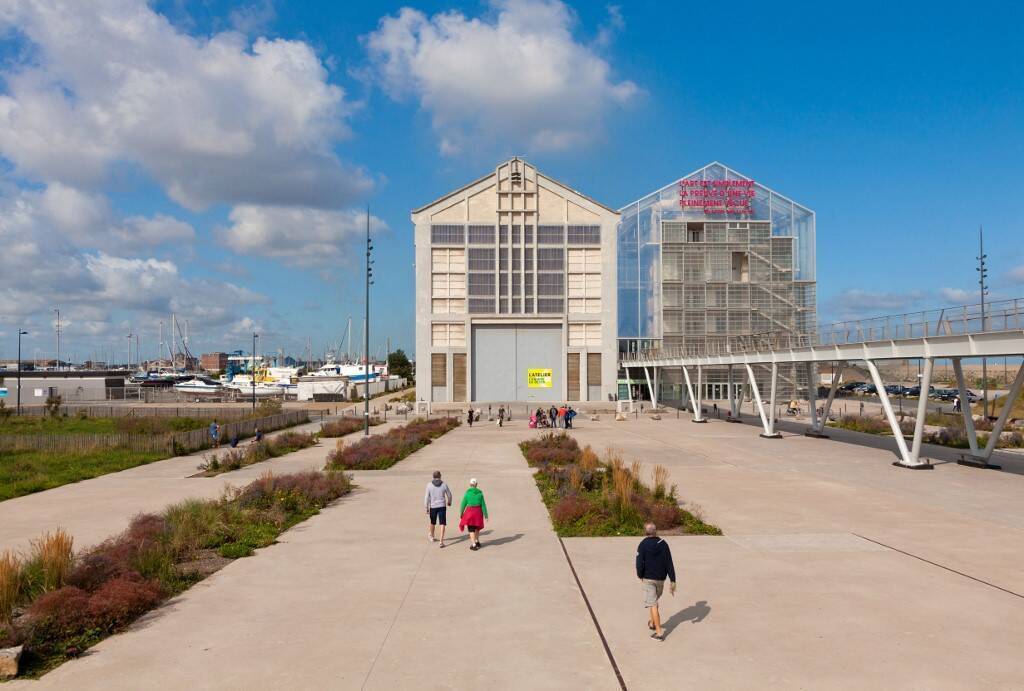
FRAC (2013)
The research also analyzes other internationally awarded contemporary projects that integrate renewable energy into architectural design, such as the Solar Settlement neighborhood in Freiburg or the Powerhouse Brattørkaia building in Norway. These projects demonstrate that architecture can function as a decentralized energy infrastructure capable of producing clean energy and reducing dependence on fossil fuels.
The study suggests that 21st century architecture must become a productive ecological infrastructure, capable of generating renewable energy, integrating into the landscape and actively contributing to the construction of a society less dependent on oil.
1. Architecture in the post-oil era:
For much of the 20th century, architecture developed in an energy context dominated by the relative abundance of fossil fuels. Oil, coal and natural gas provided a cheap energy source that allowed the development of buildings highly dependent on mechanical air conditioning, ventilation and artificial lighting systems.
In this energy model, architecture was primarily conceived as a spatial container whose climatic functioning depended on external technological systems. The availability of cheap energy allowed the development of buildings with large glass surfaces, little attention to solar orientation and air conditioning systems highly intensive in energy consumption.
However, the energy crisis of the 1970s and, subsequently, growing scientific evidence on climate change have deeply questioned this energy model. The building sector represents a very significant proportion of global energy consumption and carbon emissions, which has driven a profound transformation in the architectural discipline.
In this new context, the concept of energy architecture emerges, which proposes conceiving buildings as active systems capable of producing and managing their own energy. This approach includes the development of positive energy buildings capable of generating more energy than they consume throughout the year through integrated renewable technologies.
Architecture thus begins to play a central role in the global energy transition. Buildings are no longer simple consumers of energy but become infrastructures capable of producing clean electricity and contributing to the decarbonization of cities.
Furthermore, this energy transformation also implies a cultural change in the way of conceiving architectural design. Solar orientation, natural ventilation, thermal inertia and the relationship with the landscape once again play a fundamental role in the design process.
2. Architecture as an energy harvesting machine:
Architecture can be understood as a climate machine capable of interacting with the energy flows of the environment. This concept implies that the building does not limit itself to protecting its inhabitants from external weather conditions, but actively uses these conditions to generate thermal comfort and energy.
The main energy capture technologies integrated in architecture include solar, geothermal, wind systems and passive bioclimatic design strategies.
Solar collection:
Solar energy is the most widely used renewable resource in architecture. Buildings have large surfaces exposed to solar radiation, which allows roofs and facades to be converted into active energy generation surfaces.
Photovoltaic panels allow solar radiation to be transformed into electricity using semiconductor cells. These systems can be integrated directly into the architectural envelope using solutions known as BIPV (Building Integrated Photovoltaics).
In addition to photovoltaic systems, buildings can incorporate solar thermal collectors to produce domestic hot water or heating.
Bioclimatic greenhouses:
A particularly interesting strategy consists of incorporating winter gardens or greenhouses, which function as intermediate spaces between the interior and exterior of the building.
These spaces capture solar radiation during the winter and act as thermal mattresses that reduce heat loss. In summer they can be opened completely to allow natural ventilation.
This strategy was explored in a paradigmatic way in the Casa Latapie by Lacaton & Vassal.
Geothermal energy:
Geothermal systems take advantage of the constant temperature of the subsoil to air condition buildings using heat pumps. These systems make it possible to significantly reduce energy consumption associated with heating and cooling.
Passive strategies:
Passive strategies include the use of architectural techniques that allow the energy performance of the building to be improved without resorting to complex mechanical systems.
These strategies include:
-Solar orientation
-Cross ventilation
-Thermal inertia
-Sun protection
-Advanced thermal insulation
The combination of these strategies turns the building into a complex energy system capable of adapting to changing climatic conditions.
3. Lacaton & Vassal projects as paradigms of energy architecture:
The Latapie House, built in 1993 in Floirac near Bordeaux, constitutes one of the most influential examples of contemporary bioclimatic architecture.
The project is characterized by the incorporation of a large polycarbonate greenhouse facing east that functions as an intermediate space between the interior of the home and the exterior.

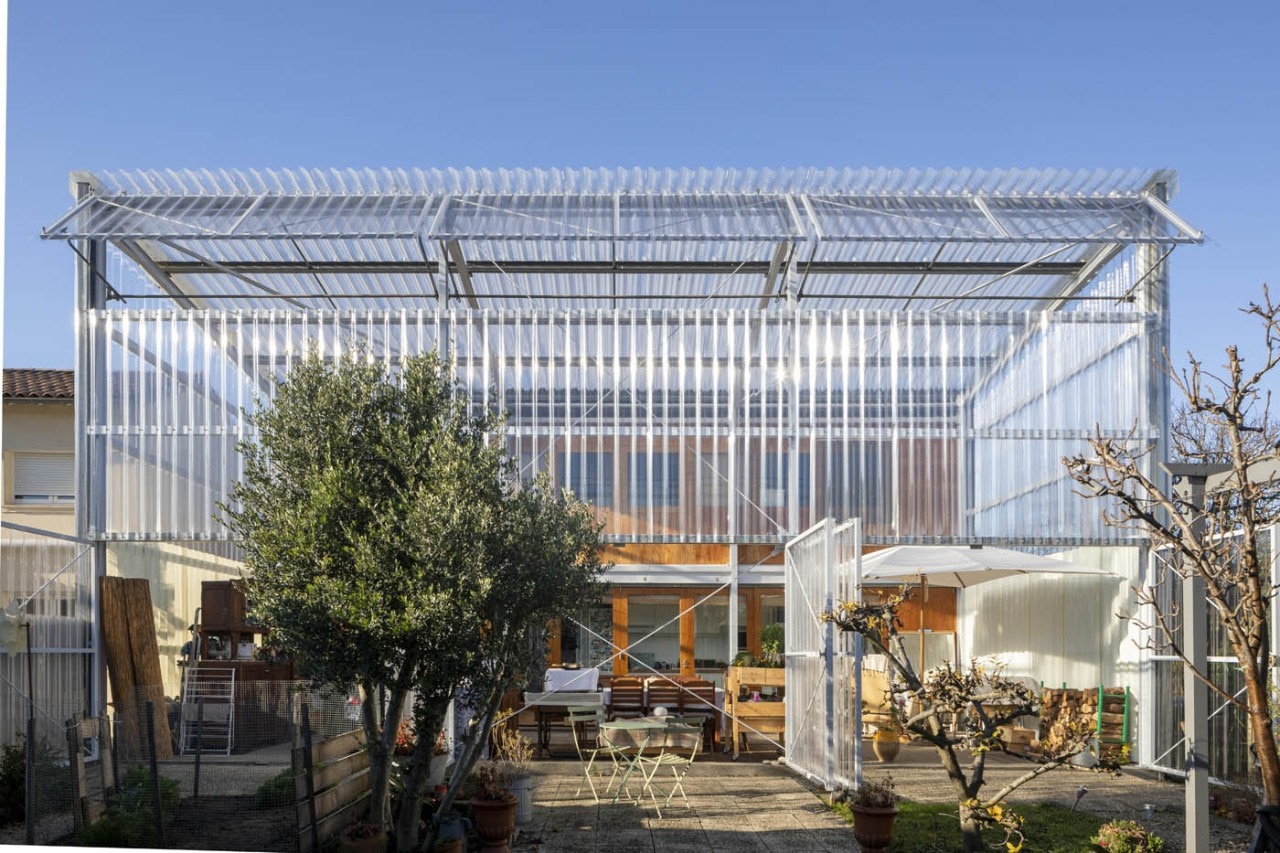
This translucent space captures solar radiation during the winter and creates a thermal cushion that reduces the building’s energy consumption. The greenhouse functions as a winter garden that expands the living space of the home and allows the use of the building to be adapted to the climatic conditions.
The building is made up of two main volumes:
-An insulated inner core constructed of lightweight materials
-A translucent exterior structure that functions as an intermediate climatic space
This system allows the house to modify its degree of openness depending on the season of the year. During the winter the greenhouse behaves as a passive solar collector, while in summer it can be opened completely to allow natural ventilation.
The Latapie House represents a paradigmatic example of ecological architecture because it demonstrates that it is possible to significantly improve the energy performance of a building through simple and economical strategies.
The project has been widely published in architectural magazines and books and has influenced numerous subsequent investigations into sustainable architecture and social housing.
The research initiated in the Latapie House was subsequently developed by Lacaton & Vassal in numerous collective housing and urban rehabilitation projects.
One of the most influential examples is the transformation of the social housing blocks at Grand Parc Bordeaux, where architects added winter gardens and balconies to the existing buildings.
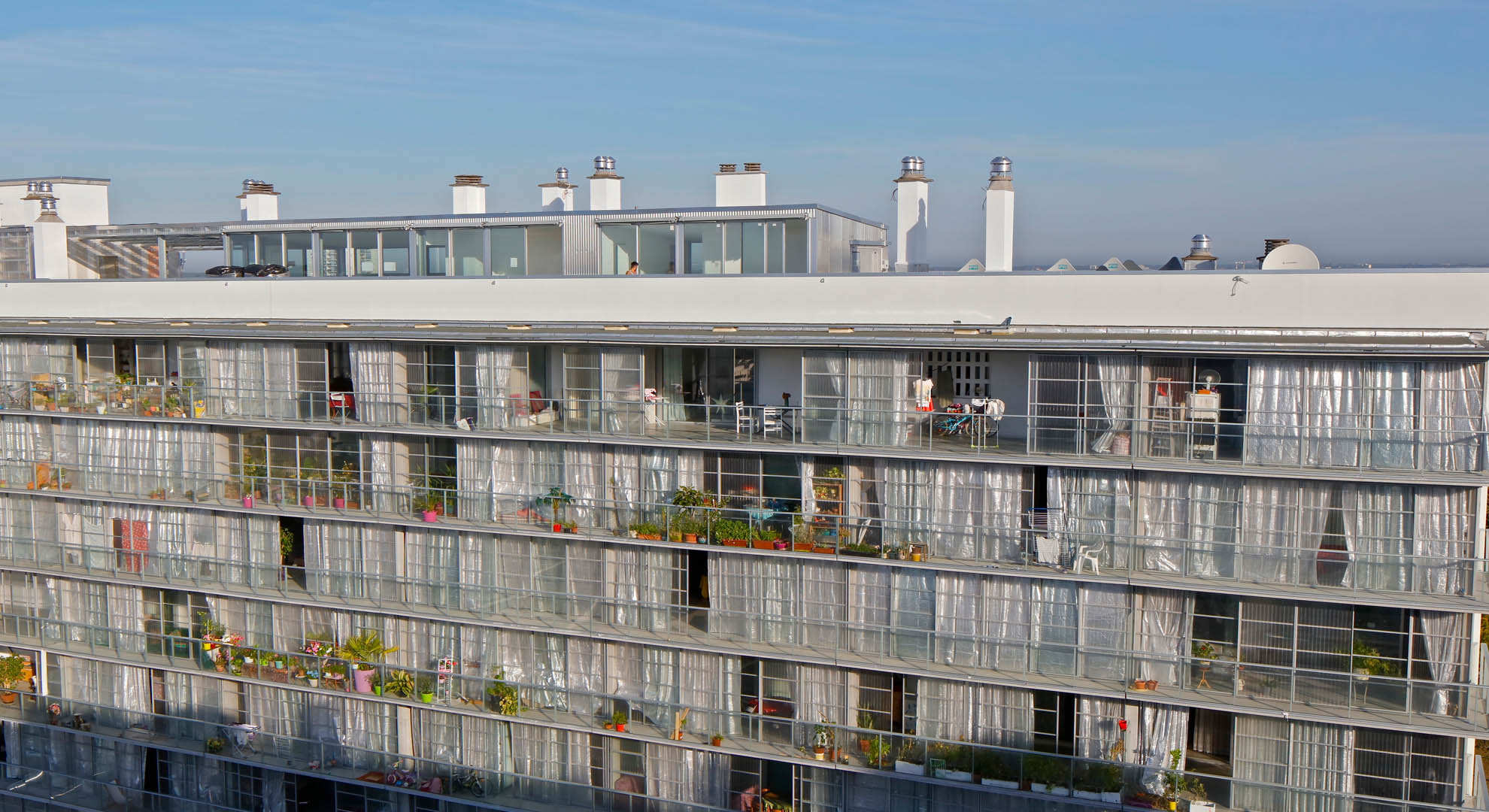
Facade detail of one of the collective housing buildings of the Grand Parc Bordeaux (2018)
This strategy allowed the thermal comfort of the homes to be significantly improved without the need to demolish the original buildings.
Another relevant project is the rehabilitation of the Tour Bois-le-Prêtre in Paris, where a similar strategy was applied based on the expansion of the apartments using light structures and winter gardens.
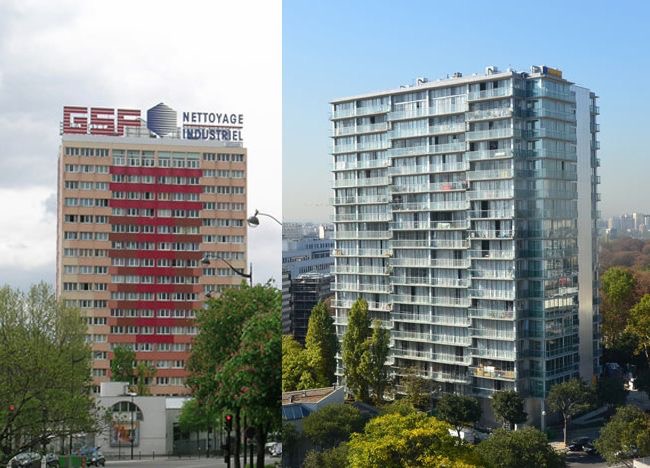
Tour Bois-le-Prêtre (2011)
These projects demonstrated that sustainable architecture does not necessarily involve the construction of new buildings, but can also be achieved through the intelligent transformation of the existing residential stock.
Lacaton & Vassal’s work has received numerous international recognitions, culminating with the Pritzker Architecture Prize in 2021, one of the most prestigious awards in the world.

The FRAC Nord-Pas de Calais project, built in 2013 in Dunkirk, constitutes one of the most important works of Lacaton & Vassal and a significant example of contemporary climatic architecture.
The building is located next to a former industrial shipyard and adopts an architectural strategy based on doubling the volume of the existing building. The architects built a new transparent volume that exactly reproduces the dimensions of the original industrial warehouse.
This light structure is wrapped with a translucent skin that generates a large interior climatic space. This space functions as a kind of large-scale urban greenhouse, capable of regulating the thermal conditions of the building through natural ventilation and solar collection.
The transparent envelope allows the building to function as a large climate machine that adapts its interior conditions according to the seasons. Furthermore, the transparency of the volume establishes a direct visual relationship with the port landscape of Dunkirk.
The project represents an evolution of the intermediate space concept previously developed in the Latapie House, expanding it to an institutional and urban scale.
The FRAC Dunkerque demonstrates that sustainable architecture can be developed through simple spatial strategies based on light structures, natural ventilation and the use of solar energy.
4. Internationally awarded energy architecture:
_Solar Settlement (Freiburg)
The Solar Settlement neighborhood in Freiburg is one of the best-known examples of energy urbanism.
The homes incorporate photovoltaic roofs facing south capable of producing more energy than they consume. This concept is known as Plus Energy House.
The project received numerous international awards and became a world reference in solar architecture.
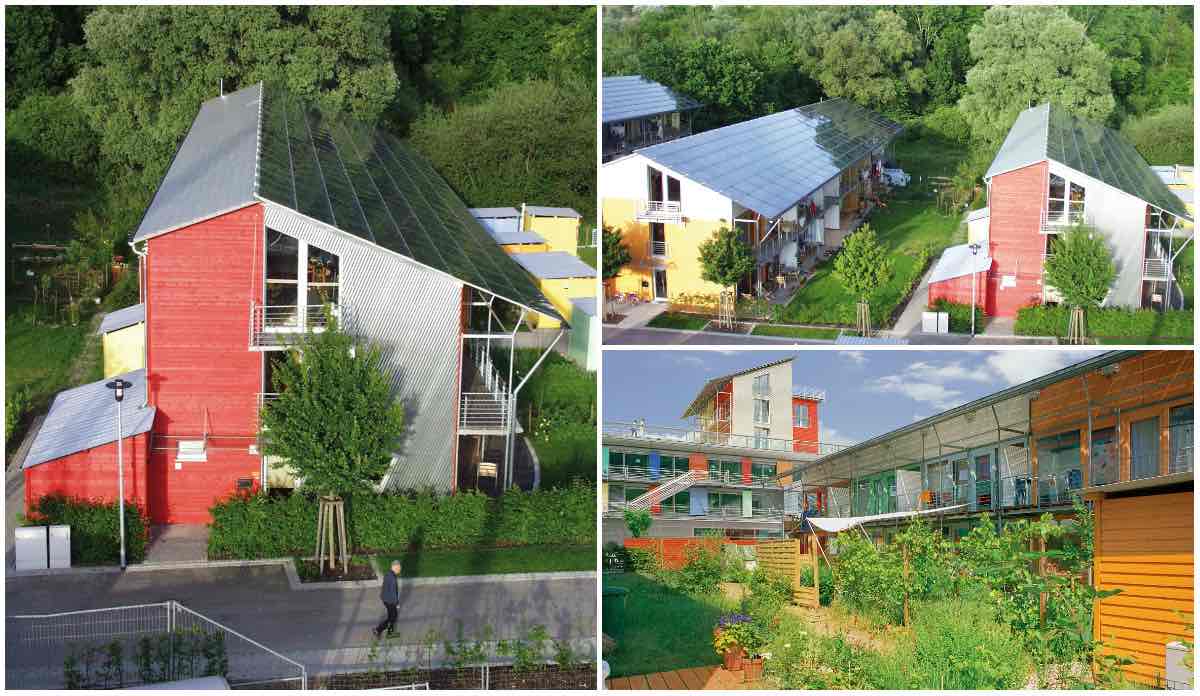
Solar Settlement (2005)
_Powerhouse Brattørkaia
The Brattørkaia Powerhouse building, designed by Snøhetta studio in Trondheim, Norway, is one of the most advanced positive energy buildings in Europe.
Its sloping roof covered in solar panels produces more than double the energy the building consumes.
This project demonstrates that architecture can function as an urban energy plant integrated into the landscape.


5. Architectural aesthetics and energy landscape:
One of the fundamental challenges of energy architecture is to integrate renewable technologies into an architectural aesthetic coherent with the territory and the landscape.
The most advanced contemporary projects demonstrate that energy systems can become compositional elements of architectural design.
Solar roofs can define the shape of the building, while winter gardens can generate intermediate spaces that enrich the spatial experience.
This aesthetic integration contributes to creating a new energy landscape aesthetic, in which technology, nature and architecture combine to produce sustainable built environments.
Conclusions:
Contemporary architecture is in a moment of profound transformation driven by the need to reduce dependence on fossil fuels and adapt to a sustainable energy model.
The examples analyzed demonstrate that buildings can become energy capture machines integrated into the landscape, capable of producing clean energy and improving climate comfort.
Projects such as the Latapie House show that ecological architecture does not depend only on complex technologies, but also on intelligent spatial strategies capable of taking advantage of the natural resources of the environment.
The architecture of the future must combine energy efficiency, landscape integration and technological innovation to build sustainable cities capable of responding to the environmental challenges of the 21st century.
Bibliography:
-Banham, R. (1984). The Architecture of the Well-Tempered Environment. University of Chicago Press.
-Lacaton, A., & Vassal, J-P. (2017). Freedom of Use. Barcelona: Gustavo Gili.
-IEA – International Energy Agency (2021). Net Zero by 2050.
-IPCC (2022). Climate Change Mitigation Report.
-Heinze, M., & Voss, K. (2009). “Goal: Zero Energy Building – Experience from the Solar Settlement Freiburg”.
-Snøhetta (2019). Powerhouse Brattørkaia Project Report.
-United Nations Environment Programme (2020). Global Status Report for Buildings and Construction.

