
Architecture in the face of the housing crisis
Political economy of living, design principles and lessons from award-winning contemporary architecture
The current housing crisis in Spain is manifested as one of the main vectors of social, territorial and generational inequality. The sustained increase in rental and purchase prices, structural inflation, the rise in urban land prices and the tax pressure on construction have created a scenario of limited access to decent housing for broad sections of the population. This article maintains that this crisis cannot be interpreted solely as a dysfunction of the real estate market, but as the result of an exhausted housing model, incapable of responding to contemporary social, economic and environmental transformations.
Based on an interdisciplinary approach that combines urban theory, typological analysis and study of award-winning contemporary architecture projects, the text argues that architecture has a real scope for action in the face of the crisis. In particular, principles such as spatial flexibility, passive architecture, intelligent densification, collective housing and sustainable industrialization are analyzed.
Keywords: housing crisis, contemporary architecture, affordable housing, residential typology, sustainability, housing economy.
- Introduction. From the real estate crisis to the housing crisis:
Housing has gone, in the Spanish and European context, from being a basic social right to becoming a central financial asset within the globalized economy. This displacement, widely documented by urban critical literature (Harvey, D. (2012). Rebel cities: From the right to the city to the urban revolution. Verso.), has generated a profound distortion between the use value and the exchange value of housing. The direct consequence is a progressive disconnection between architecture and habitability, where the residential project is subordinated to logics of profitability, standardization and value extraction.
In Spain, this process has been aggravated by the legacy of the expansive real estate cycle of previous decades, by a tax structure that penalizes the production of affordable housing and by urban planning that, in many cases, has prioritized extensive expansion over the regeneration of the existing fabric (MITMA. (2023). Housing and land observatory. Ministry of Transport, Mobility and Urban Agenda.).
From this perspective, the housing crisis is inseparable from a cultural crisis of living. It is not only about how many homes are built, but about what type of homes, for what ways of life and under what economic and social regime.
- Theoretical framework. Housing, space and political economy:
Henri Lefebvre already pointed out that space is not a neutral container, but a social product (Lefebvre, H. (1974). La production de l’espace. Anthropos.). Housing, as the dominant spatial form of the contemporary city, directly reflects the power relations, economic models and cultural structures that produce it.


Henri Lefebvre (1971) and cover of La production de l’espace. Anthropos (1974).
In the current context, housing is under double pressure: on the one hand, it must respond to growing demands for energy efficiency, sustainability and spatial quality; On the other hand, it is inserted in a highly stressed market, where land and buildings become instruments of financial accumulation.
Architecture is therefore situated in an ambivalent position: it can reinforce these dynamics or, on the contrary, operate critically on them through typological, constructive and urban decisions.
- Structural housing crisis in Spain. Diagnosis:
Recent data show that the economic effort allocated to housing far exceeds the thresholds recommended by international organizations, especially in large urban areas and tourist territories (Eurostat. (2022). Housing statistics in the European Union. https://ec.europa.eu/eurostat). This situation not only generates residential exclusion, but also directly impacts social mobility, birth rates, mental health and urban cohesion.
Policies focused exclusively on price control or tax incentives are insufficient if they are not accompanied by a thorough review of the architectural and urban model. At this point, architecture stops being an aesthetic discipline and becomes a social technology.
- Project principles in the face of the crisis. Critical Insight:
4.1. Passive architecture as structural economy:
Passive architecture should not be understood only as an environmental strategy, but as a form of economic redistribution. Reducing the energy demand of a home implies reducing the household’s recurring expenditure, something especially relevant in contexts of energy inflation and economic precariousness (Olgyay, V. (1963). Design with climate. Princeton University Press.).
In the Casa Calixto project, the adaptation to the territory and orientation does not respond to a formal will, but among other reasons to a logic of material and climatic economy. The home is conceived as a precise thermal artifact, where each design decision has direct consequences on the cost of use. This approach places architecture in an active position in the face of the energy and economic crisis, demonstrating that design can operate as a redistributive tool (Gor, Á. (2019). Casa Calixto. https://www.alvarogor.com).
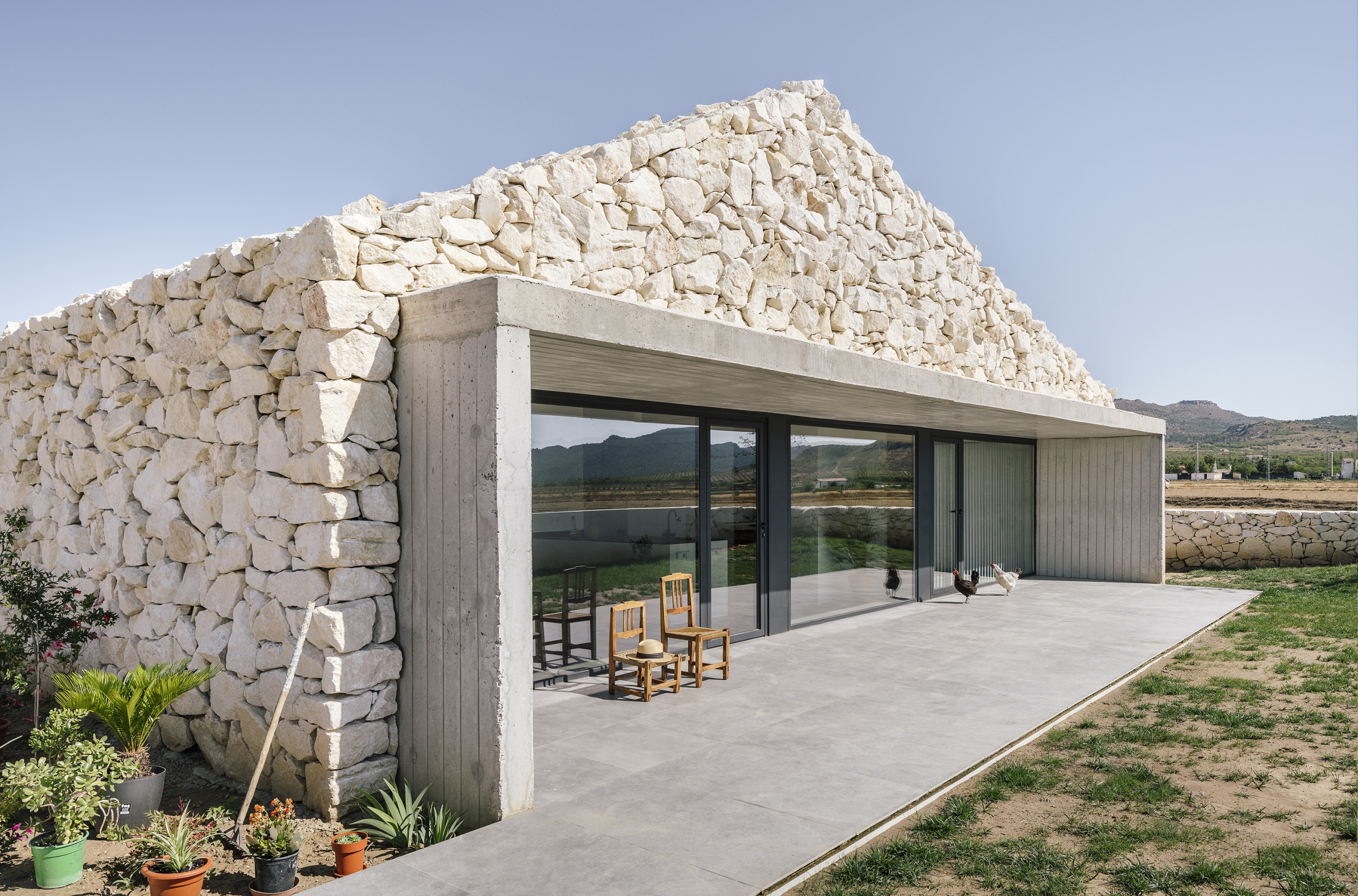
Calixto House (2019). Puebla de Don Fadrique (Granada).
4.2. Spatial precision and minimum non-precarious housing:
The reduction of surface area has historically been associated with the loss of quality. However, contemporary architecture demonstrates that spatial precision can generate more efficient, adaptable and dignified homes.
Casa Pavaneras is part of this critical tradition. The rehabilitation of a historic home in the center of Granada is approached from a logic of extreme optimization of space, through the elimination of residual corridors, the overlapping of uses and the design of architectural furniture. The project questions the equivalence between size and comfort, proposing a replicable model for stressed urban centers. (Gor, Á. (2015). Casa Pavaneras. https://www.alvarogor.com).

Pavaneras House (2015). Realejo neighborhood (Granada).
- Collective housing, community and sharing economy:
Award-winning projects such as Modulus Matrix or La Borda show a shift from individualized housing towards cooperative and community models. This change is not only social, but deeply economic: sharing resources means reducing structural and energy costs (RIBA. (2024). RIBA International Awards for Excellence. Royal Institute of British Architects.).

Modulus Matrix (2020). Cornellà de Llobregat (Barcelona).

La Borda housing cooperative (2018). Barcelona.
Collective housing thus reappears as a social infrastructure, capable of generating support networks and reducing the economic vulnerability of households.
- Industrialization, wood and control of the construction process:
Industrialization should not be interpreted as a loss of architectural quality, but as a recovery of process control. In a sector historically exposed to cost overruns, delays and waste of resources, industrialized systems make it possible to introduce economic predictability and technical precision (Fundació Mies van der Rohe. (2024). EU Prize for Contemporary Architecture. https://miesarch.com).
The growing presence of structural wood in award-winning projects reinforces this logic, by combining environmental sustainability with construction speed and structural weight reduction.
- Housing, care and life cycles:
The recognition of Appleby Blue Almshouse highlights an often forgotten issue: housing is not neutral with respect to body, age or health. Designing for care implies recognizing the diversity of life cycles and rejecting homogeneous residential models (RIBA. (2025). Stirling Prize jury report. Royal Institute of British Architects.).

Appleby Blue Almshouse (2025). London.
This approach is especially pertinent in aging societies such as Spain, where housing must adapt to new forms of dependency and coexistence.
- Incrementality and participation. Rethink authorship:
The incremental model of Quinta Monroy introduces a break with the closed conception of the architectural project. By allowing progressive appropriation by the user, architecture becomes an enabling framework, not a finished object (Aravena, A. (2016). Elemental: Incremental housing and participatory design manual. Hatje Cantz.).
This logic resonates with contemporary practices that understand the project as an open, adaptable and socially situated process.

Quinta Monroy (2003). Iquique (Chile).
- The city as a housing project:
The housing crisis cannot be dissociated from urban form. Strategies such as selective densification, reuse of the existing park and mixing of uses allow reducing pressure on the land, improving urban efficiency and limiting speculative expansion (UN-Habitat. (2020). Housing at the center of the new urban agenda. United Nations.).
In this sense, domestic architecture and urban planning must be understood as interdependent scales of the same problem.
- Conclusions. Architecture as public responsibility:
In a context of economic crisis, inflation and residential inequality, architecture cannot limit itself to responding to the market. It must assume its status as a public discipline, capable of articulating spatial, social and economic responses to one of the main contemporary challenges: guaranteeing the right to live.
Literature:
– Aravena, A. (2016). Elemental: Incremental housing and participatory design manual. Hatje Cantz.
– CSCAE. (2024). Spanish Architecture Awards. Superior Council of the Colleges of Architects of Spain.
– Eurostat. (2022). Housing statistics in the European Union. https://ec.europa.eu/eurostat
– Frampton, K. (2002). Labour, work and architecture. Phaidon.
– Mies van der Rohe Foundation. (2024). EU Prize for Contemporary Architecture. https://miearch.com
– Gor, Á. (2019). Calixto House. https://www.alvarogor.com
– Gor, Á. (2015). Pavaneras House. https://www.alvarogor.com
– Harvey, D. (2012). Rebel cities: From the right to the city to the urban revolution. Verse.
– Lefebvre, H. (1974). The production of space. Anthropos.
– Mazzucato, M. (2021). Mission economy: A moonshot guide to changing capitalism. Penguin.
– MITMA. (2023). Housing and land observatory. Ministry of Transport, Mobility and Urban Agenda.
– Olgyay, V. (1963). Design with climate. Princeton University Press.
– RIBA. (2024). RIBA International Awards for Excellence. Royal Institute of British Architects.
– RIBA. (2025). Stirling Prize jury report. Royal Institute of British Architects.
– UN-Habitat. (2020). Housing at the center of the new urban agenda. United Nations.

