
ARCHITECTURE WITHOUT BORDERS: TOWARDS A PLANETARY TERRITORY BASED ON GLOBAL ECOLOGY, BIOREGIONS AND UNIVERSAL GOVERNANCE
This article proposes a broad narrative-scientific framework to understand Architecture without borders as an emerging discipline capable of responding to the ecological, territorial, cultural and political challenges of the 21st century. A vision is developed where architecture is conceived as a bridge between diverse territories, not as a set of isolated objects or tied to state borders but rather united to their biological territories. Through a deep narrative approach supported by contemporary theories—planetary urbanization, bioregionalism, political ecology, anthropology of territory and philosophy of living—it is argued that future architecture must respond to a planet understood as a continuous system. Authors such as Calvino, Rudofsky, Fuller, Latour, Raworth, Otto, Ito and Schlesinger support this vision, expanded here with scientific rigor and extensive conceptual development. The text concludes by defending an architectural paradigm that reconnects humanity with the biosphere and turns the planet into a platform for cooperation, ecological balance and spatial justice.
Keywords: architecture without borders, planetary territories, political ecology, architectural bioregionalism, global urbanization, anthropology of living.

Planet Earth from satellite photography (2013). Photography: ESA.
GENERAL INTRODUCTION: THE WORLD BEFORE AND AFTER BORDERS
When you observe the topography of the planet from space you experience a revelation: the Earth is a continuous body, a single landscape with no visible dividing lines. This uninterrupted totality should be the basis of all architectural reflection, but human societies have built on it a network of artificial borders that transform what is one into multiple fragments (Latour, B. (2018). Down to Earth: Politics in the New Climatic Regime. Polity Press).
Political borders, although deeply rooted in our imagination, do not exist in nature. They are the result of contingent historical processes: wars, conquests, treaties, diplomatic negotiations and identity narratives. However, when we look at the planet from an ecological perspective, we see that ecosystems, winds, oceans and atmospheric cycles form an interdependent system in which no separation is possible (IPCC. (2021). Sixth Assessment Report of the Intergovernmental Panel on Climate Change).

China, Korea and Japan from space in a night view today, one of the most populated territories on the planet. Photography: NASA.
Architecture Without Borders attempts to return humanity to that initial understanding: the Earth was not designed to be divided, and human habitation should not be either. This article deeply expands on this intuition, arguing that architecture must reconnect with the territorial continuity of the biosphere and operate at the real scale of the phenomena that shape the planet.
From the perspective of planetary urbanization, the entire earth’s surface is involved in urban processes—whether as production, extraction, consumption, connectivity, or ecological impact—which implies that the contemporary city does not have clear limits (Brenner, N., & Schmid, C. (2015). Towards a new epistemology of the urban? City, 19(2–3), 151–182). Architecture without borders, therefore, is not only a philosophical project but a logical consequence of the current state of the world.
Beyond the technique, this article proposes a narrative vision: humanity is facing a historical bifurcation. Either it continues to reinforce the borders that separate it—with walls, narratives of exclusion, and unequal economic systems—or it inaugurates a planetary model of coexistence, where architecture acts as a bridge, suture, and catalyst for a new ecological contract.
THE EARTH AS A CONTINUOUS ORGANISM: NARRATIVE AND SCIENTIFIC FOUNDATIONS
The Earth functions like an organism. This statement, expanded with academic rigor, connects with contemporary theories that describe the planet as a complex self-regulating system (Margulis, L., & Sagan, D. (2000). What Is Life?. University of California Press). Architecture without borders emerges from this vision because it understands that human habitation cannot be isolated from the terrestrial metabolism.
The biosphere functions through continuous interactions between atmosphere, lithosphere, hydrosphere and biosphere. This continuity is expressed in:
– Global atmospheric circulation,
– Biogeochemical cycles,
– Fauna migratory patterns,
– Ocean flows,
– The processes of photosynthesis and planetary respiration.
None of these systems recognize borders. The air that is breathed today, for example in the city of Granada, was in the Atlantic a few days ago, and before that in the southern hemisphere. The water of a river does not stop its course at a border control.
When borders are drawn on this global organism, dysfunctions occur:
– Disruption of ecological corridors (WWF. (2020). Living Planet Report 2020. World Wide Fund for Nature),
– Pressure on migratory species (IPBES. (2019). Global Assessment Report on Biodiversity and Ecosystem Services. Intergovernmental Science-Policy Platform on Biodiversity and Ecosystem Services),
– Degradation of shared basins,
– Conflicts over resources,
– Fragmentation of ancestral territories.
Architecture without borders is, then, the natural response to reconnect these metabolic tissues. If the atmosphere is one, so is the climate. If the climate is one, also the habitation should be one. If living is one, Architecture without borders is inevitable.
ARCHITECTURE AND TERRITORY: THE PLANET AS NARRATIVE CONTINUITY
Architecture is due to the territory where it is created. It constitutes one of the strongest conceptual keys to reinterpret the discipline from a planetary vision. In this narrative and scientific expansion, the territory is not conceived as a surface delimited by borders, but as a geohistorical organism whose identity is formed by millennia of ecological, cultural and climatic processes (Ingold, T. (2000). Evolving skills. Alas, poor Darwin: Arguments against evolutionary psychology).
A territory is the visible and invisible sum of biogeographic sedimentations: mountain chains formed by ancient tectonic collisions, glacial valleys shaped during ice ages, river basins that have nourished forests, grasslands and entire civilizations. These geological structures know no political boundaries, but rather constitute continuities that predate humanity by millions of years (Wilson, E. O. (2016). Half-Earth: Our Planet’s Fight for Life. Liveright Publishing).
Architecture without borders, by expanding this approach, recognizes that each construction is inserted into a pre-existing living tissue. A building is not born in a vacuum: it is born within an ecological network that extends across continents. Understanding this is not only a scientific act, but an ethical act. Building involves conversing with the earth and not imposing itself on it.
In addition to being a physical support, the territory is populated with stories, mythologies, languages, agricultural practices, exchange routes and ancestral knowledge. Human cultures did not develop within current countries; They developed following rivers, mountains, seas, deserts and seasons. Before modern borders existed, there were pastoral routes, transcontinental caravans, maritime networks, and early human migrations (Escobar, A. (2015). Territories of Difference. Duke University Press).
From this perspective, Architecture without Borders not only unites ecosystems: it unites cosmologies. It allows cultures to dialogue through a material language that recognizes local particularities without locking them into the narrow framework of a national State.
The territory is a metabolic system. Soils breathe, seas move, forests grow, species migrate. When the original document states that architecture should unite territories with different topographical characteristics, it is anticipating a central idea of contemporary bioregionalism: only ecological continuity can sustain life in the long term (Aberley, D. (1993). Boundaries of Home: Mapping for Local Empowerment. New Society Publishers).
Expanded narrative architecture deepens this vision: building on a planet without borders implies designing for a territory that is not static, but dynamic. The territory changes every second, with each hydrological cycle, with each season, with each atmospheric transformation. The architecture must adapt to this flow.
BIOREGIONS AS THE FOUNDATION OF PLANETARY LIVING
The concept of bioregion represents one of the most solid contributions to reimagine the future of the planet without borders. Bioregions are units defined not by political agreements, but by ecological patterns: climate, relief, soils, flora, fauna, water availability and associated cultural practices (Aberley, D. (1993). Boundaries of Home: Mapping for Local Empowerment. New Society Publishers).
In a planet without borders, bioregions would be the new operational territories. Architectural, urban and economic decisions would be made based on the ecological metabolism of each region, and not current administrative limits. This approach would allow resources to be distributed in a more equitable and regenerative way, establishing common policies between ecologically connected territories.
A bioregional architecture requires:
– Restore biological corridors,
– Design cities that function as ecological nodes,
– Integrate renewable energies adapted to each ecosystem,
– Build infrastructure that reduces ecological entropy,
– Promote the migration of species instead of blocking it.
This expanded narrative aligns with ecological biomimicry approaches, where architecture learns from patterns of resilience observed in nature (Oxman, N. (2016). The age of entanglement. Journal of Design and Science, 1, 1–24).
Each bioregion of the planet—the Andes, the Mediterranean, the Himalayas, the Congo Basin, the Arctic tundra, the Pacific islands—expresses an ecological and cultural diversity that Architecture without Borders must protect and connect. Instead of homogenizing the territory, this amplified architecture recognizes the richness of each place and integrates it into a continuous planetary network.
PLANETARY THINKERS: CALVINO, FULLER, RUDOFSKY, OTTO AND ITO
In The Invisible Cities, Calvino (1972) describes cities that do not exist on maps, but in the imagination, in emotions, in memory and in desires. Each city that Marco Polo narrates is a mirror of the possible world. Architecture without borders is inspired by this vision: cities are not united by geographical limits, but by spiritual affinities, by networks of meanings that transcend physical space.
Calvino anticipates an architecture that does not belong to any political territory, but to universal human experience. “The city does not say its past, it contains it like the lines of a hand” (Calvino, I. (1972). Le città invisibili. Einaudi). This quote expresses the idea that the territory is a living archive and that architecture is its legible form.
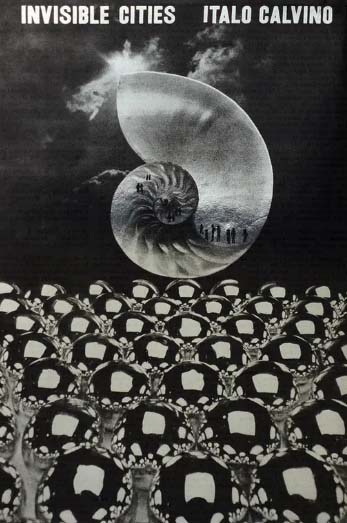
Cover of the first edition of The Invisible Cities, by Italo Calvino (1972).
In Architecture Without Architects, Bernard Rudofsky (1964) demonstrated that humanity has lived for millennia without qualified architects, but never without architecture. Vernacular societies built in harmony with topography, climate and culture, creating construction systems that did not recognize political borders, but rather ecological and cultural units.
Architecture without borders recognizes this ancient wisdom and integrates it with contemporary technologies. Rudofsky defended a humble architecture, embedded in the earth, that grows like an organism. His work here becomes an epistemological foundation for imagining a planetary architecture.

“Architecture Without Architects” exhibition at the Museum of Modern Art in New York (1964).
Richard Buckminster Fuller was one of the first thinkers to affirm that the planet is like a closed ship where all systems are interconnected. His vision of “Spaceship Earth” (Fuller, R. B. (1969). Operating Manual for Spaceship Earth. Southern Illinois University Press) has become one of the most powerful metaphors for understanding the future of human habitation.
Fuller proposed that technology should not serve to dominate nature, but rather to improve the planet’s metabolic efficiency. Its geodesic domes anticipated architectures that can exist in any territory but also adapt to it, regardless of political borders. Architecture without borders amplified in this article incorporates this idea to propose light, adaptable and regenerative construction systems.

The iconic geodesic dome of the 1967 Montreal World’s Fair (Expo 67) was the United States Pavilion, designed by visionary architect Buckminster Fuller.
Frei Otto conceived architecture as a biological phenomenon. Its tensional structures are inspired by natural models—leaves, spider webs, cell membranes—that function thanks to the efficient distribution of forces. Otto broke with the traditional categories of solid architecture, proposing instead flexible, mobile and ecological architectures.
These structures do not belong to a country; They belong to the planet. They can be installed without destroying the landscape, connect with ecological corridors and coexist with wildlife. They are architectures that, like ecosystems, adapt to the environment.
Toyo Ito conceives buildings as extensions of invisible flows: information, wind, light, energy, human movement. In works such as the Sendai Media Library (1997), architecture becomes porous, permeable and dynamic. This vision is essential for a planet without borders where cities must behave like living organisms.
Ito maintains that “architecture should reflect the complexity of contemporary life.” Architecture without borders expands this idea to a planetary level: contemporary life is no longer local, but global.
THE UN: THE FIRST POLITICAL BUILDING ON THE ENTIRE PLANET
After the Second World War, humanity understood that violence between states was unsustainable. The UN emerged as an attempt to avoid global collapse through an organization based not on borders, but on universal principles (Schlesinger, S. (2003). Act of Creation: The Founding of the United Nations. Westview Press). It was a historic moment in which it was proposed, for the first time, that humanity had to act collectively to survive.
The UN building in New York, designed in collaboration with Le Corbusier and Oscar Niemeyer, is perhaps the first building built explicitly not to belong to any country. Its architecture is a manifesto of transparency and modernity. The large glass surfaces symbolize the need to see and be seen. The absence of national monumentality expresses an intention: the UN is not just another State, but a shared political space.
Beyond its building, the UN is a complex architecture made up of multiple organizations: UNESCO, WHO, FAO, UNICEF, UN-Habitat. Each of them operates on planetary scales, addressing problems that no country can solve alone: pandemics, food crises, global education, cultural heritage, sustainable urbanism.

UN Headquarters (NYC), under construction in December 1949.
Architecture Without Borders draws inspiration from these institutions to imagine a future where bioregions, not states, manage the planet’s resources.
TOWARDS A NEW PLANETARY CONTRACT
Architecture without borders is more than a technical project; It is a civilizational horizon. It represents an ethical pact between humanity and the Earth. It proposes an economy that does not depend on unlimited growth, an urban planning that does not destroy biodiversity, a policy that does not use borders as weapons.
This article argues that 21st century architecture must become a regenerative discipline capable of healing territories, reconnecting cultures and guaranteeing the continuity of life. In an interdependent planet, Architecture without borders is no longer an option: it is a historical necessity.
The concept of Architecture without Borders is much more than an aesthetic or philosophical aspiration. It is, at its core, a civilizational project. As the planet faces climate, water, energy, migration and economic crises that exceed any individual state, architecture must assume a decisive role as a mediator between humans and the biosphere (Raworth, K. (2017). Donut Economics: Seven Ways to Think Like a 21st-Century Economist. Chelsea Green Publishing). Its mission can no longer be limited to the design of objects, but must expand to the configuration of entire territories through principles of ecological justice, community resilience and shared responsibility.
In this unified and expanded version of the article, Architecture without borders emerges as a comprehensive model of living, capable of simultaneously integrating local, regional, bioregional and planetary scales. It is not about erasing cultural identity, but about amplifying it within a broader framework where diversity is celebrated, cooperation becomes essential, and ecological continuity is the basis of all development.
Architecture without borders invites humanity to recognize itself as an interdependent species that shares a common home. The idea that economics should be an equitable right arises not from naïve idealism, but from a scientific understanding that extreme inequality inevitably leads to environmental and social crises. On a planet where natural resources are on the verge of collapse, economic justice and ecological justice are two sides of the same coin (Sassen, S. (2014). Expulsions: Brutality and Complexity in the Global Economy. Harvard University Press).
If the 20th century was marked by industrial expansion, the 21st century must be marked by environmental regeneration. Architecture Without Borders will be a regenerative architecture: one that restores ecosystems, repairs degraded soils, revitalizes polluted rivers and allows biodiversity to thrive again. It will be an architecture that accompanies the rhythms of the planet, that reduces entropy and that aligns with the biosphere instead of opposing it.
A world without borders is not a homogeneous world. It is a world where each bioregion maintains its particularity, where cultures dialogue in equality, where territories connect as chapters of a larger narrative. A planetary architecture does not impose globalized forms, but rather builds ecological and cultural bridges that respect the diversity of the planet.
If in the past imagining a planet without borders seemed utopian, today it is an urgent need. Contemporary crises cannot be understood or resolved from the limited framework of nation-states. The architecture of the future must become a discipline that integrates science, ecology, economics, culture, technology and philosophy. In its highest form, it will be a discipline capable of imagining possible futures and constructing them collectively.
CONCEPTUAL EXPANSION: TOWARDS AN INTEGRAL THEORY OF PLANETARY ARCHITECTURE
To continue the narrative and scientific expansion of the article, this part delves into the theoretical formulation that supports Architecture without borders as an emerging disciplinary field. Although the previous sections have introduced ecological, philosophical, bioregional and political dimensions, this section seeks to articulate a robust conceptual framework that allows understanding the full scope of an architecture designed for a continuous planet.
Traditionally, architecture has been understood as a discipline of object production. This vision, inherited from modern thought, privileges the building as an independent unit, with its own physical and symbolic limits. However, from a planetary perspective, this notion is insufficient. Architecture without borders must be conceived not as an object, but as a system of relationships that crosses scales and territories (Ingold, T. (2000). Evolving skills. Alas, poor Darwin: Arguments against evolutionary psychology.).
Under this premise, each building becomes:
– An ecological interface,
– A cultural node,
– An atmospheric mediator,
– An energy bridge,
– A social and biopolitical agent.
The planet without borders demands an architecture that thinks topologically, not geometrically. Topology studies the shapes that can be transformed without losing continuity. If we apply this idea to the planet, an Architecture without borders is not organized by closed blocks, but by continuous surfaces that adapt to ecological and cultural transitions.
The architecture of the future must be organized around materialities that reduce entropy, regenerate ecosystems and optimize resources (Oxman, N. (2016). The age of entanglement. Journal of Design and Science). This implies:
– The use of biomaterials,
– 3D printing on a territorial scale,
– Structures adaptable to the climate,
– Buildings that act as carbon sponges,
– Productive infrastructures integrated with biodiversity.
Architecture without borders not only transforms territories but also narratives. It proposes a new way of being in the world, where each architectural action recognizes that the planet is a common home. It is a political act because it questions the modern geopolitical order, and it is poetic because it imagines new ways of life based on cooperation, justice, and ecological continuity (Haraway, C. (2016). Staying with the Trouble: Making Kin in the Chthulucene. Duke University Press).
An Architecture without borders can only exist within an economic system that prioritizes:
– Global equity,
– Universal access to resources,
– Clean energy,
– Transregional food sovereignty,
– Technical cooperation between bioregions.
This approach aligns with Raworth’s donut economics (Raworth, K. (2017). Donut Economics: Seven Ways to Think Like a 21st-Century Economist. Chelsea Green Publishing), which proposes a model where human well-being is kept within the ecological limits of the planet.
Therefore, a planetary architecture must focus on:
– Reduce vulnerabilities,
– Distribute resources equitably,
– Anticipate climate crises,
– Protect displaced populations,
– Strengthen community autonomy.
On a planet without borders, spatial justice is not an ethical aspiration, but a requirement for collective survival.
APPLIED PLANETARY ARCHITECTURE: FUTURE SCENARIOS FOR A WORLD WITHOUT BORDERS
To continue the in-depth expansion of this article and consolidate the narrative framework developed in the previous parts, this section proposes conceptual scenarios that illustrate what a planet governed not by political borders, but by ecological, bioregional and cultural continuities would be like. These visions are not exercises in science fiction, but logical derivations of the theoretical principles established by authors such as Latour (Latour, B. (2018). Down to Earth: Politics in the New Climatic Regime. Polity Press), Raworth (Raworth, K. (2017). Donut Economics: Seven Ways to Think Like a 21st-Century Economist. Chelsea Green Publishing), Haraway (Haraway, C. (2016). Staying with the Trouble: Making Kin in the Chthulucene. Duke University Press) and Brenner & Schmid (Brenner, N., & Schmid, C. (2015). Towards a new epistemology of the urban? City).
SCENARIO 1: CITIES AS BIOREGIONAL NODES
On a planet without borders, cities would cease to be administrative entities and become interconnected bioregional nodes. There would be no national capitals, but rather ecological coordination centers. Each city would function as a living laboratory where:
– Regenerative infrastructures,
– Low entropy mobility,
– Decentralized energy networks,
– Intensive conservation policies,
– Community systems of mutual care.
These node cities would not compete with each other; They would collaborate. Their architectures would be dialogic, permeable, adapted to the diversity of climates and ecosystems. Instead of walls, there would be transitional spaces that guide transit between biomes.
SCENARIO 2: GLOBAL ECOLOGICAL CORRIDORS
Ecological fragmentation is one of the main factors of biodiversity loss (WWF. (2020). Living Planet Report 2020. World Wide Fund for Nature). A planet without borders would allow biological corridors to be restored on a continental scale, so that migratory species can move from the Arctic to the Sahara, or from Patagonia to Alaska.
Architecture, in this context, would cease to be a barrier and become a facilitating infrastructure. Buildings that function as bridges for fauna, skyscrapers that integrate vertical forests, sunken roads to allow the passage of herds, water infrastructures that simulate natural wetlands. This is a type of architecture where non-human life is the protagonist.
SCENARIO 3: SHARED CLIMATE TERRITORIES
Climate phenomena know no borders. On a planet without geopolitical divisions, regions affected by droughts, heat waves, floods or glacial melt would be coordinated as climatic units, not as isolated countries. Architecture would have a key role in mitigation and adaptation:
– Climate shelter systems,
– Transregional water distribution infrastructure,
– Homes designed for thermal resilience,
– Regenerative productive landscapes that restore degraded soils.
SCENARIO 4: PLANETARY FOOD SOVEREIGNTY
Agricultural architecture—bioclimatic greenhouses, hydraulic terraces, aquaponic platforms, edible forests—would be a structural part of the territory. Food sovereignty would no longer depend on volatile global markets and would be based on:
– Resilient polycultures,
– Bioregional seed exchange,
– Shared agronomic technologies,
– Design of regenerative food infrastructure.
SCENARIO 5: GLOBAL GOVERNANCE BASED ON BIOREGIONS
Finally, the most consistent future with a borderless planet would be a global governance structure organized around bioregions. The UN, as the previous document points out, would be the first transition institution towards this model. Its role would evolve from diplomacy between nations to coordination between ecologically interdependent territories.
The political architecture of the planet would change:
– Bioregional parliaments,
– Transclimatic research centers,
– Ecological embassies,
– Globalized public infrastructure networks.
THE HORIZON OF A PLANETARY ARCHITECTURE
We can summarize that an architecture without borders is not an ideal, it is an ecological necessity. The territorial continuity of the planet requires that architecture stop designing limits and start designing connections.
Bioregions are the political-ecological units of the future, replacing countries, restoring ecosystems and balancing human and non-human needs.
The UN represents the first attempt at planetary governance, but it needs to evolve towards a structure capable of managing ecological territories, not isolated sovereign states.
Living is the central political act of the 21st century, and architecture is the discipline that defines how humanity exists on the planet.
The future will be regenerative, or there will be no future. Architecture without borders is the most coherent model with the survival of the biosphere and human dignity.
Planetary architecture, in short, is not simply a professional field: it is a civilizational project aimed at redefining how humanity relates to itself and the Earth.
PHILOSOPHICAL DIMENSIONS OF A PLANET WITHOUT BORDERS
This conceptually dense expansion of the article responds to the need to articulate an ontological basis that sustains the paradigm shift towards a planet governed by ecological continuities, living systems and diverse cultural networks.
- THE BEING-IN-THE-PLANETARY WORLD
The phenomenological tradition, especially in Heidegger and Merleau-Ponty, conceives of inhabiting not as occupying a space, but as a way of being-in-the-world. On a planet without borders, this idea is amplified: the human being is no longer “situated” in a territory and becomes involved in a planetary network of relationships.
Living becomes:
– Participate in the rhythms of the Earth,
– Correspond to ecological cycles,
– Accept cohabitation with other species,
– Recognize the absolute interdependence between territories.
- ONTOLOGY OF INTERDEPENDENCE
Authors such as Latour (Latour, B. (2018). Down to Earth: Politics in the New Climatic Regime. Polity Press) maintain that modern thought separated the human being from nature, creating two fictitious spheres: culture vs. nature. In Architecture without borders, this dichotomy collapses. There is no longer a natural outside or a human inside: there is a socio-ecological continuum where all beings, human and non-human, are part of the same fabric of existence.
- ETHICS OF PLANETARY CARE
Architect and theorist Donna Haraway proposes an ethics based on “making kinship” (Haraway, C. (2016). Staying with the Trouble: Making Kin in the Chthulucene. Duke University Press). From this ethic, caring for the planet is not an abstract moral obligation, but rather a daily and relational act. Architecture without borders embodies this ethic when it designs infrastructures that take care of ecosystems, communities, territories and future generations.
ANTHROPOLOGY DIMENSION: PEOPLE, CULTURES AND CONTINUITY WITHOUT BORDERS
This section expands the anthropological dimension of the article, recognizing that human culture has never been contained within the borders that we know today.
Cultures are flows, not containers. They have migrated, they have mixed, they have created routes of exchange and knowledge since prehistoric times. A planet without borders allows this cultural movement to recover its original nature.
Vernacular architectures demonstrate that towns separated by thousands of kilometers developed similar solutions when they shared similar ecological conditions. This confirms that borderless architecture does not eliminate cultural diversity: it places it in its real ecological context.
In a world without borders, cultural rights no longer depend on national citizenship. They become planetary rights: access to land, water, education, mobility, protection of territory and the preservation of cultural memory.
Architecture without borders requires recognizing that many indigenous peoples inhabited the planet for millennia without establishing rigid borders. Its worldview, based on the continuity of the territory and respect for the biosphere, becomes a reference model for the future.
Aesthetics are fundamental in architecture. On a planet without borders, beauty takes on a different meaning: it is no longer a symbol of national power or an expression of dominant architectural styles, but rather an emotional bridge between territories.
Planetary beauty arises from:
– Harmonious integration with the landscape,
– Living materials that evolve over time,
– Shapes inspired by biodiversity,
– Structures that respect their environment,
– Buildings that breathe instead of oppress.
The architectures of different cultures dialogue without hierarchies. There are no “superior” styles: they are all legitimate expressions of the human relationship with the territory.
Every built form tells a story. On a planet without borders, these stories intertwine across continents, creating a visual poetics that transcends languages and geographies.
FINAL SYNTHESIS OF THE ARTICLE: TOWARDS A PLANETARY PACT FOR LIVING
Architecture without borders is neither an isolated concept nor a utopian fantasy. It is the logical result of a deep reading of the current state of the planet. Throughout this article it has been shown that the political separation of territory is incompatible with the ecological and bioregional dynamics that sustain life on Earth.
The architecture of the future must assume its responsibility: to be the discipline that translates ecological science into habitable forms, that converts planetary ethics into real spaces and that materializes a policy of global cooperation in sensitive infrastructures for humans and non-humans.
Architecture must be designed for a continuous territory where each biome is respected as a sacred unit. Only collaboration between peoples, cultures and territories can sustain a just and regenerative model of life. Each building must bring life back to the territory, rebuild ecosystems and support climate continuity. Every person has the right to live with dignity, access to water, clean energy, adequate housing and interbioregional mobility. Architecture must look after those who have not yet been born.

“Earthrise” photograph, taken by astronaut William Anders, during the Apollo 8 mission in 1968. The first color photograph of the Earth from the Moon.
When humanity is observed from a distance—like astronauts photographing the Earth from a vacuum—perception changes forever. That blue sphere, without lines, without walls, without divisions, is the most powerful image ever produced by technology. That undivided planet is the truth. The borders are the myth.
If architecture is the tool with which humanity shapes the world, then the time has come for it to give up building separation and start building union. To abandon extractive logic and embrace regeneration. That it recognizes that the survival of the species is linked to the health of the biosphere.
We are children of a planet without borders. Now we must build as such.
BIBLIOGRAPHY
Aberley, D. (1993). Boundaries of Home: Mapping for Local Empowerment. New Society Publishers.
Brenner, N. (2014). Implosions/Explosions: Towards a Study of Planetary Urbanization. Jovis.
Brenner, N., & Schmid, C. (2015). Towards a new epistemology of the urban? City, 19(2–3), 151–182.
Calvino, I. (1972). Le città invisibili. Einaudi.
Escobar, A. (2015). Territories of Difference. Duke University Press.
Fuller, R. B. (1969). Operating Manual for Spaceship Earth. Southern Illinois University Press.
Ghosh, A. (2016). The Great Derangement: Climate Change and the Unthinkable. University of Chicago Press.
Haraway, C. (2016). Staying with the Trouble: Making Kin in the Chthulucene. Duke University Press.
IPBES. (2019). Global Assessment Report on Biodiversity and Ecosystem Services. Intergovernmental Science-Policy Platform on Biodiversity and Ecosystem Services.
IPCC. (2021). Sixth Assessment Report of the Intergovernmental Panel on Climate Change.
WWF. (2020). Living Planet Report 2020. World Wide Fund for Nature.
Latour, B. (2018). Down to Earth: Politics in the New Climatic Regime. Polity Press.
Margulis, L., & Sagan, D. (2000). What Is Life?. University of California Press.
Oxman, N. (2016). The age of entanglement. Journal of Design and Science, 1, 1–24.
Raworth, K. (2017). Doughnut Economics: Seven Ways to Think Like a 21st-Century Economist. Chelsea Green Publishing.
Rudofsky, B. (1964). Architecture Without Architects: A Short Introduction to Non-Pedigreed Architecture. Museum of Modern Art.
Sassen, S. (2014). Expulsions: Brutality and Complexity in the Global Economy. Harvard University Press.
Schlesinger, S. (2003). Act of Creation: The Founding of the United Nations. Westview Press.
Wilson, E. O. (2016). Half-Earth: Our Planet’s Fight for Life. Liveright Publishing.
Ingold, T. (2000). Evolving skills. Alas, poor Darwin: Arguments against evolutionary psychology.

