



A home on the border between Granada and its Vega
Casa Bobadilla is proposed as an territorial project that transcends the domestic scale to become an architectural reflection on the landscape, history and contemporary ways of living.

Territorial diagram
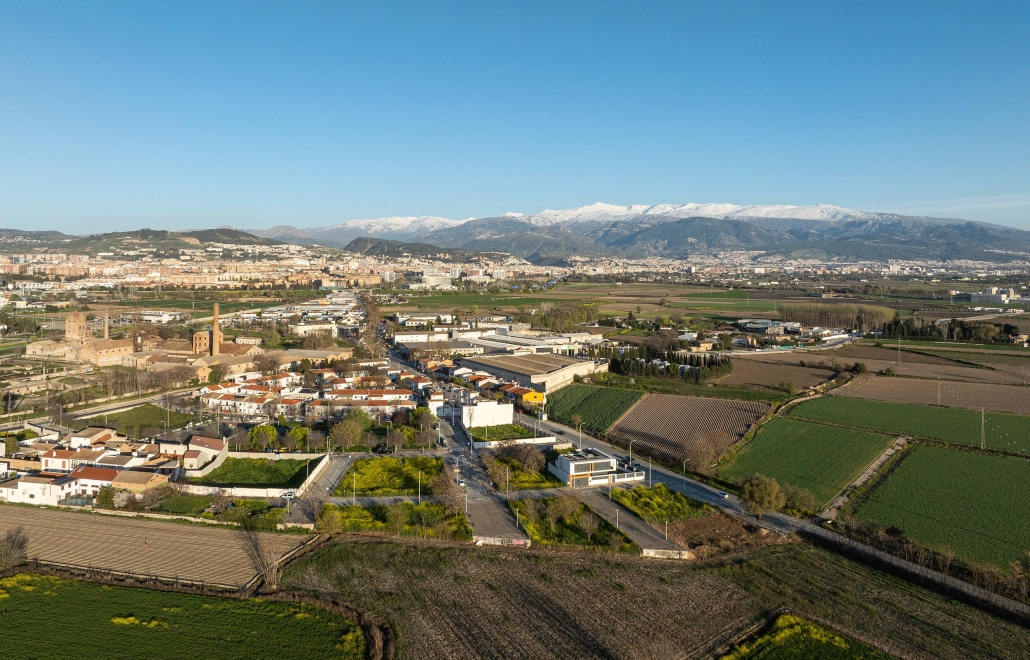
Located on the diffuse edge where the city progressively dissolves into the agricultural territory, the house assumes a strategic and symbolic position. This place of transition—neither completely urban nor strictly rural—condenses many of the tensions that have defined the recent evolution of Granada and its plain: urban expansion, the fragmentation of productive land and the loss of landscape continuity. Faced with this, Casa Bobadilla proposes an architecture that does not impose itself, but rather dialogues, interprets and integrates.
The project seeks to blend in with its environment through precise and deeply rooted references. Towards the east, the imposing presence of the Sierra Nevada defines a recognizable horizon line, whose inclined geometry and broken profile translate into the volumetry of the home. The roofs reinterpret the tradition of ceramic tiles through inclined planes that evoke snow-capped peaks, while the dominant white color refers to both vernacular architecture and the luminosity of the mountain.
Towards the west, the influence of the Vega de Granada becomes visible in multiple layers of the project. The architecture of the tobacco drying rooms – functional, permeable and climate-adapted structures – inspires the façade perforations, designed to optimize cross ventilation and the entry of natural light. These openings not only respond to bioclimatic criteria, but also reinterpret a traditional construction language from a contemporary sensibility.

Territorial scheme of Bobadilla House
Likewise, the house incorporates elements typical of the agricultural landscape, such as the characteristic poplar of the Vega, integrating vegetation that acts as a climatic and visual filter. The presence of orchards and productive spaces between the facade and the plot recovers the historical logic of the Vega as a metabolic system linked to daily life.
The historical and cultural context amplifies the meaning of the project. From the plot it is possible to establish visual and symbolic relationships with landmarks of the territory such as the Alhambra or the old industrial sugar factories, such as San Isidro or the San Juan Mill, vestiges of a productive memory that marked the economic development of the region.
In construction terms, Casa Bobadilla is committed to material honesty and durability. The use of exposed concrete responds both to economic criteria—reducing the need for additional finishes—and to a desire for permanence: an architecture designed to age with dignity, resistant to the passage of time and oblivious to ephemeral fashions. This choice reinforces the idea of housing as a stable element within a territory in constant transformation.
Sustainability is actively integrated through the incorporation of solar panels, which allow progress towards energy self-sufficiency and reduce dependence on fossil sources. This strategy is not presented as a technological addition, but as a coherent extension of the relationship between architecture and environment.
Another significant element is the access to the home, resolved through a large gate that refers to the traditional farmhouses and mansions of Granada. However, its design has been reinterpreted from a contemporary logic, becoming a threshold that articulates memory and innovation.
The relationship with the built fabric of the Bobadilla neighborhood is also fundamental. In this hybrid environment, where homes and agro-industrial structures coexist, the house is inserted respecting the existing scales, materials and typologies, avoiding unnecessary formal breaks. In this way, the project not only dialogues with the natural landscape, but also with the built one.
In a context where the Vega de Granada has been progressively fragmented by aggressive urban dynamics, Casa Bobadilla is positioned as a critical alternative. It proposes a way of living that recognizes the value of the productive territory, that recovers historical links between city and landscape, and that proposes a domesticity rooted in the local without renouncing contemporaneity.
In short, more than a home, Casa Bobadilla is a piece of mediation between two worlds. A project that understands architecture as a tool to reconnect with the environment, reinterpret tradition and project new forms of coexistence between the urban and the agricultural.

Distribution plants of Bobadilla House
Collaborators:
Eduardo Alonso Tejedor, Alejandro Fernández Martínez, Paula Agúndez Hisado, Antonio Jesús Gutiérrez, María García, Rebeca Pereira, Basile Pousin, Nélida Jerónimo, Alexandra Bailey, Elena López, Claudia Wallace.
Promoters: Ana María, Manuela, Lola and Juande.
Builders: Construcciones Alcadavi and Daniel García Construcciones.
Structure and installations: Elesdopa and Eduardo Serrano (es+arquitectura).
Technical architect: José Manuel Segura Hernández.
Photographer: Juanan Barros.
RESEARCH ARTICLE:

