
The Moon: global heritage or appropriable territory?
Architecture, geopolitics and visual culture in the first extraterrestrial frontier
The Moon has ceased to be solely an astronomical or cultural object to become a territory of comprehensive project, where multiple disciplines converge: international law, aerospace engineering, extractive economics, geopolitics and, centrally, architecture. This convergence makes the satellite the first scenario where humanity must design a completely artificial habitat from scratch.
Unlike terrestrial architecture, which has historically operated in dialogue with the climate, geography and available materials, lunar architecture faces an absolutely hostile environment: absence of atmosphere, extreme radiation, variable temperatures and reduced gravity. This implies that architecture stops being a practice of adaptation and becomes a practice of producing living conditions.
In this context, the question of property takes on a radical dimension. It is not only about who controls the territory, but about who defines the conditions of habitation, who designs the spaces, who establishes the rules of use and who has access to these new environments. The Moon, therefore, is not only a territory to be colonized, but a total political-architectural project.

1. Expanded legal framework: contradictions and future scenarios:
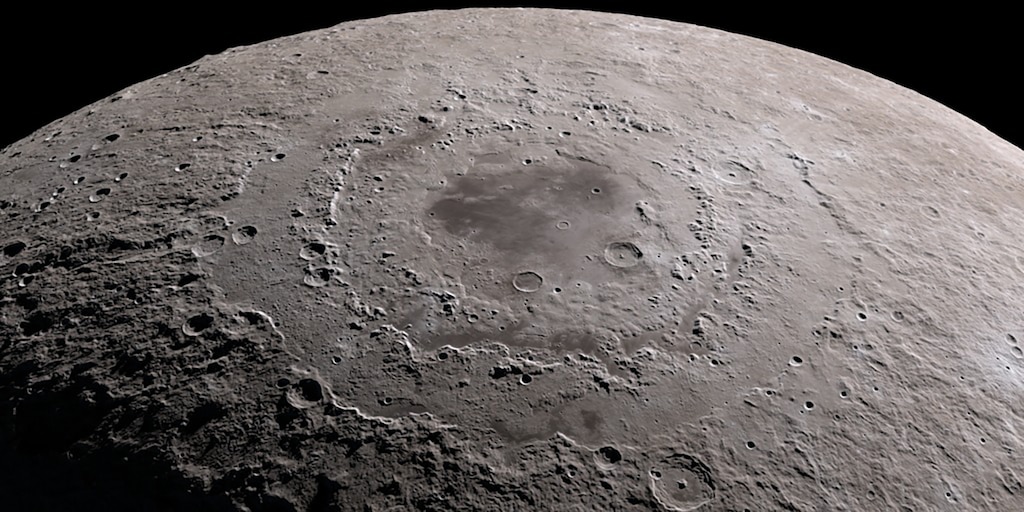
The Outer Space Treaty establishes that no State can appropriate the Moon. However, this seemingly clear principle faces multiple contemporary reinterpretations.
The Moon Treaty attempted to consolidate the idea of the Moon as a common heritage, but its limited ratification has turned it into a weak instrument. In practice, we are witnessing an evolution towards a hybrid model where:
-The territory is not formally appropriable.
-Resources can be exploited.
-Infrastructures can be controlled.
This model generates an unprecedented spatial condition: a territoriality without explicit sovereignty, but with effective control. From architecture, this implies the proliferation of autonomous enclaves that function as micro-territories.
In this sense, architecture becomes the mechanism through which appropriation is materialized. Although you cannot legally own the Moon, you can own the structures built on it, generating a form of indirect control.
2. Ideological models and their architectural translation:
The future occupation of the Moon will not depend solely on technological advances, but on the ideological models that guide its development. Each way of understanding ownership, resource use and international cooperation inevitably translates into a certain spatial configuration. In this sense, architecture does not act as a neutral discipline, but as a material language that expresses political and economic systems.
Through the global cooperative and extractive-corporate models, it is possible to observe how different visions of the world generate radically different architectures: from open, modular and shared infrastructures, to closed, highly specialized and exploitation-oriented enclaves. The Moon thus becomes a stage where ideology is literally constructed, giving rise to new ways of living that reflect—and amplify—the tensions present on Earth.
_Global cooperative model
This model is inspired by precedents such as the International Space Station, where multiple countries collaborate on a common infrastructure.
The International Space Station represents an architecture based on modular aggregation. Each module has been designed by different countries, but they are all integrated into a common system. This logic is fundamental for the Moon, since it allows:
-Progressive growth.
-Technological compatibility.
-Distribution of responsibilities.
The architecture here is not a closed object, but an open system in constant evolution. This model could be transferred to the Moon through a network of interconnected bases, where each country or entity provides specific modules.

International Space Station
_Extractive and corporate model
In this model, the Moon is conceived as a territory of exploitation.
Future lunar mining will feature highly specialized infrastructure, designed to maximize resource extraction. These architectures have specific characteristics:
-Closed and pressurized spaces.
-High automation.
-Separation between work and living areas.
This type of architecture tends to be hierarchical and functionalist, where productive efficiency dominates spatial quality. The human experience is subordinated to the industrial process.
3. Real architectural projects:
Beyond theoretical and cinematographic imaginaries, lunar architecture begins to take shape through real research and design projects, developed by space agencies and reference architecture studios. These projects not only explore technical solutions to inhabit an extreme environment, but also test new forms of relationships between technology, materiality and space.
In this context, architecture ceases to be an abstract speculation and becomes a field of applied experimentation, where each proposal responds to concrete physical conditions—radiation, vacuum, reduced gravity—but also to conceptual decisions about how to inhabit the Moon. From the occupation of natural cavities to 3D printing with local materials or the use of resources such as ice, these projects anticipate possible futures in which architecture will be able to generate not only shelter, but also experience, identity and meaning in a completely foreign territory.
_Habitats in lava tubes
These projects, investigated by the European Space Agency, propose using natural cavities.

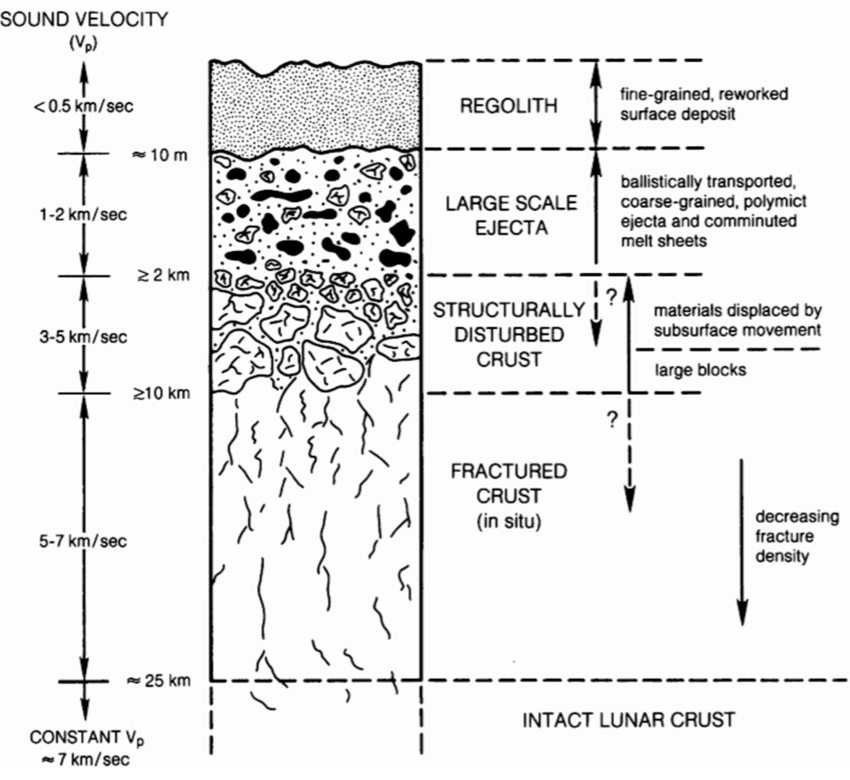
Lava tubes are tunnels formed by ancient volcanic eruptions. On the Moon, these spaces can reach enormous dimensions, making them ideal candidates for hosting human bases.
Architecturally, this implies:
-Minimize structural construction.
-Take advantage of existing geology.
-Design habitable interiors within natural cavities.
This approach redefines architecture as an adaptive occupancy practice, where design focuses on interior fit-out rather than exterior construction.
_Moon Village
Developed by the European Space Agency together with Foster + Partners.
The Moon Village project proposes an architecture based on 3D printing of lunar regolith. This approach allows structures to be built directly on the surface without the need to transport materials from Earth.
Key elements:
-Printed structural domes.
-Inner inflatable cores.
-Modular systems.
This architecture combines two logics:
- High technology (3D printing).
- Economy of resources (use of local material).
Furthermore, its modular nature allows different countries to contribute to the expansion of the settlement, reinforcing its global dimension.


Images from the Moon Village project.
4. Cinema as an anticipatory space of extraterrestrial architecture:
Science fiction cinema has historically functioned as a speculative laboratory of architecture, a field in which to test, without the limitations of immediate reality, the forms, spaces and systems that could define living in extreme contexts. In the case of the Moon, this projectual dimension acquires a particular relevance: even before there are real consolidated settlements, cinema has already built complex spatial imaginaries that anticipate not only technical solutions, but also political, economic and social models.
Far from being mere sets, the architectures represented in the cinema constitute true critical devices, capable of revealing the ideological tensions underlying each proposal for lunar colonization. In these fictional environments, the arrangement of spaces, materiality, scale and the relationship between individual and infrastructure are not neutral decisions, but direct expressions of a certain conception of the world.
Thus, films like 2001: A Space Odyssey, Moon or Ad Astra not only imagine possible futures, but also build coherent architectural models that oscillate between scientific cooperation, corporate exploitation and the expansion of global capitalism. Through them, cinema allows us to analyze how lunar architecture could become the setting where the power structures that already operate on Earth are materialized—or questioned.
In this sense, the study of cinema is not accessory, but fundamental: it offers a field of reflection where architecture is freed from the strictly technical to place itself at the center of the debate on the future of human habitation beyond the planet.
_2001: A Space Odyssey
Directed by Stanley Kubrick, this work constitutes one of the most influential references in the construction of the extraterrestrial architectural imaginary. The Clavius lunar base, located under the surface of the satellite, is presented as a highly rationalized space system, where each element responds to a logic of technical precision and absolute environmental control.
From an architectural point of view, the interior spaces are characterized by a clean, white and homogeneous aesthetic, in which continuous surfaces, diffuse lighting and the absence of superfluous elements predominate. This formal neutrality is not accidental: it responds to the need to create controlled, hygienic and efficient environments in a hostile environment, but it also conveys an idea of order and institutional stability.

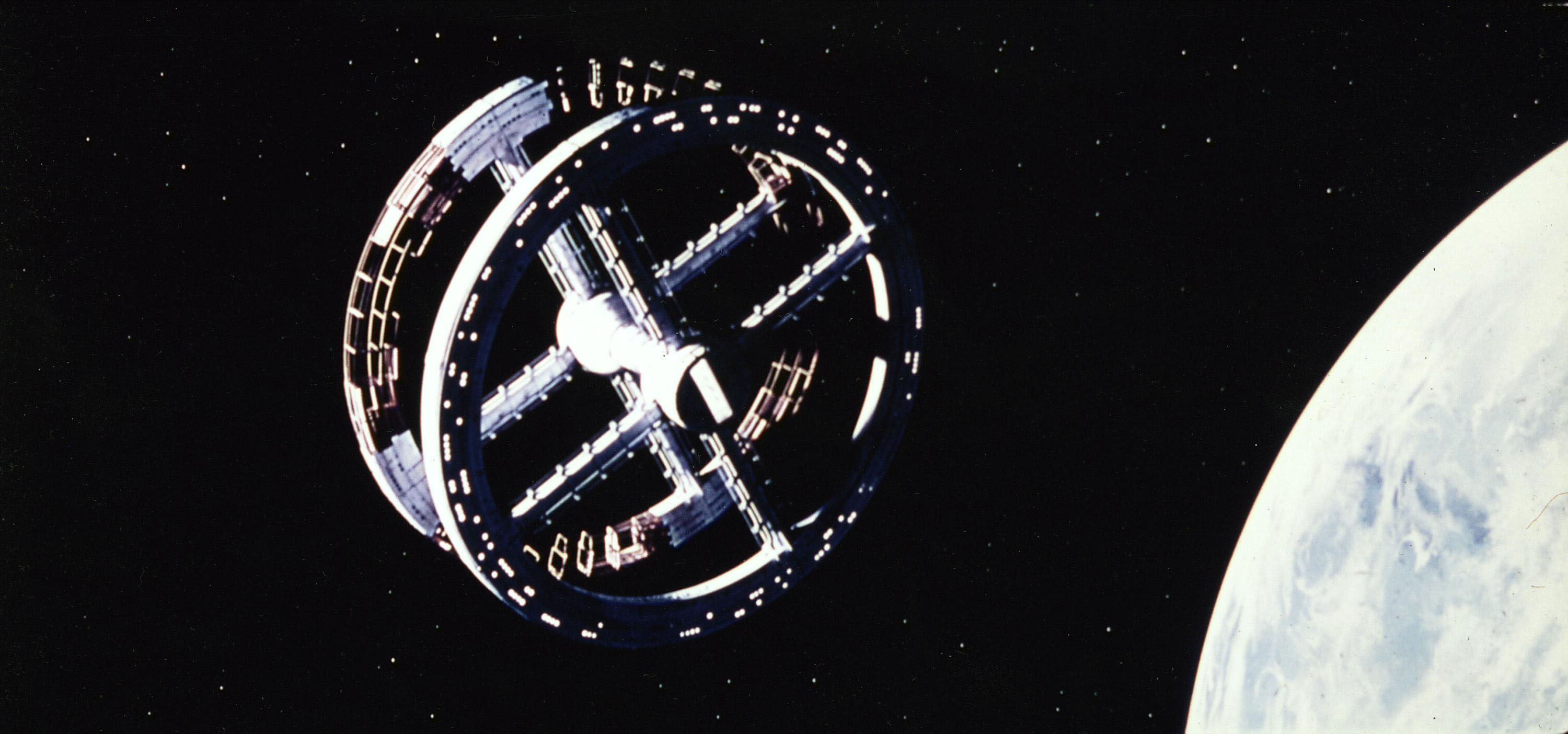


The spatial organization of the base reflects a clear functional hierarchy, with carefully differentiated areas for research, circulation and habitability. Internal transportation systems, pressurized corridors and interconnected modules anticipate solutions that today are part of real research in spatial architecture.
Beyond its technical dimension, Clavius architecture embodies a deeply optimistic vision of the future. In it, technology does not appear as a threat, but as a means to expand human knowledge. The lunar base is thus configured as an extension of science and reason, a space where architecture acts as an infrastructure of progress, facilitating exploration, cooperation and the development of new ways of living.
In this sense, 2001: A Space Odyssey not only imagines what a lunar base could be like, but also proposes a model in which architecture becomes the physical support of an advanced civilization, capable of transcending terrestrial limits through design and technology.
_Moon
In Moon, directed by Duncan Jones, lunar architecture radically departs from optimistic and technologically idealized visions to present a deeply oppressive, functional and dehumanized environment. The base where the story takes place is not conceived as a space for collective exploration or progress, but as a strictly productive infrastructure at the service of a private company.
From a spatial point of view, the environments are small, repetitive and lacking any type of significant sensory stimulation. Closed spaces, narrow corridors and rooms modulated in an almost industrial way predominate, where uniformity and monotony reinforce a constant feeling of isolation. Architecture does not seek comfort or spatial diversity, but rather operational efficiency, minimizing everything that does not directly contribute to the worker’s performance.
The materiality—metallic, cold and worn—accentuates this atmosphere of psychological wear. Unlike other brighter representations, here the lighting is artificial, limited and functional, generating harsh shadows and unwelcoming environments. All of this contributes to building an architecture that not only houses the individual, but also conditions him, controls him and, in a certain way, reduces him to just another piece of the productive system.
In this context, the lunar base becomes a work machine, where the border between habitable space and industrial space is diluted. The absence of qualified rest spaces or social relationships shows an extreme corporate logic, in which the individual is subordinated to economic objectives.
Thus, the architecture in Moon is not simply a setting, but a fundamental narrative element that materializes a critique of contemporary models of exploitation. The Moon appears here as a privatized territory, where architecture becomes an instrument of control, isolation and productivity, anticipating the risks of a colonization based exclusively on corporate interests.


Stills from the movie Moon.
The architecture in this film is oppressive and functional. The spaces are small, repetitive and lacking stimuli. This reflects a corporate logic where efficiency and control are priorities.
_Ad Astra
Ad Astra, directed by James Gray, proposes a vision of space profoundly different from the traditional epic of exploration. Rather than focusing on technological conquest, the film builds an introspective story where the external journey becomes a reflection of the protagonist’s inner world.
In this context, the Moon appears not as an unknown territory, but as a space already integrated into human dynamics, revealing an advanced stage of colonization where infrastructure, commerce and mobility have transformed the satellite into a functional extension of the Earth. This representation allows us to reflect on how architecture and urban planning can reproduce—even outside the planet—the same social, economic and spatial logics that shape our present.
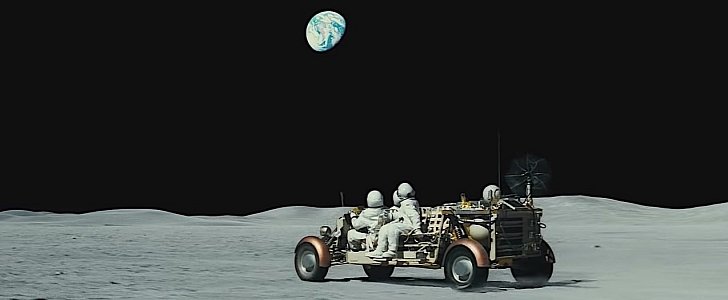

Still from the film Ad Astra.
The Moon appears as an urbanized space, with commercial and tourist infrastructures. The architecture reproduces terrestrial models, evidencing the expansion of capitalism.
All the analyzed real and fictional examples demonstrate that lunar architecture is not neutral. Each project reflects a vision of the world:
-Cooperation → open architecture.
-Exploitation → closed architecture.
-Hybridization → complex architecture.
—
In relation to the ambiguous legal frameworks, the competing ideological models and the architectural visions – both real and cinematographic – analyzed, the proposal of the extraterrestrial commons is consolidated as a critical and necessary alternative. In the face of fragmentation into autonomous enclaves or the drift towards corporate exploitation of lunar territory, this article proposes a Moon conceived as a shared infrastructure, where architecture does not delimit ownership, but rather articulates access, cooperation and habitability.
Understanding architecture as an open, modular and evolutionary system allows us to respond simultaneously to the extreme conditions of the environment and the need to build a common space. Thus, far from reproducing the territorial conflicts of the Earth – as evidenced by both the extractive projects and the dystopias of Moon or Ad Astra – the Moon can become the first territory where humanity tests a form of organization based on interdependence and collective responsibility.
In this sense, architecture takes on a central role: not only as a technical response, but as a political and cultural tool capable of making a more equitable global model tangible. The Moon will not only be a new place to live, but the stage where a shared idea of the future is projected, for the first time consciously.
Bibliography:
- United Nations. (1967). Treaty on the principles governing the activities of States in the exploration and use of outer space, including the Moon and other celestial bodies. Office for Outer Space Affairs. Viena: United Nations.
- United Nations. (1979). Agreement governing the activities of States on the Moon and other celestial bodies. Office for Outer Space Affairs. Viena: United Nations.
- NASA. (2020). NASA’s Moon to Mars Architecture Overview. Washington, DC: NASA Headquarters. Recovered https://www.nasa.gov
- European Space Agency. (2019). Moon Village: A vision for global cooperation and lunar exploration. París: ESA Publications. Recovered https://www.esa.int
- Foster + Partners. (2015). Lunar Habitats: Additive manufacturing and in-situ resource utilization. Londres: Foster + Partners Research & Development.
-
Clouds Architecture Office. (2015). Mars Ice House. NASA Centennial Challenge / 3D Printed Habitat Challenge. New York: Clouds AO. Recovered https://www.cloudsao.com
-
Stanley Kubrick. (Director). (1968). 2001: A Space Odyssey [Movie]. United Kingdom/USA: Metro-Goldwyn-Mayer.
- Duncan Jones. (Director). (2009). Moon [Movie]. United Kingdom/USA: Sony Pictures Classics.
- James Gray. (Director). (2019). Ad Astra [Movie]. USA: 20th Century Fox.

