
Between the Vega and the City: Contemporary Architecture on Avenida de Dílar
Granada unfolds toward the south as if the city—after centuries leaning against the slopes of the Alhambra—had finally decided to walk toward the Vega, following the open light of the plains. This transition, visible for barely two decades, finds one of its key points today on Avenida de Dílar, the historic axis of the Zaidín district, which has become a gateway between the traditional urban fabric and the new strip of development culminating in the Health Sciences Campus.
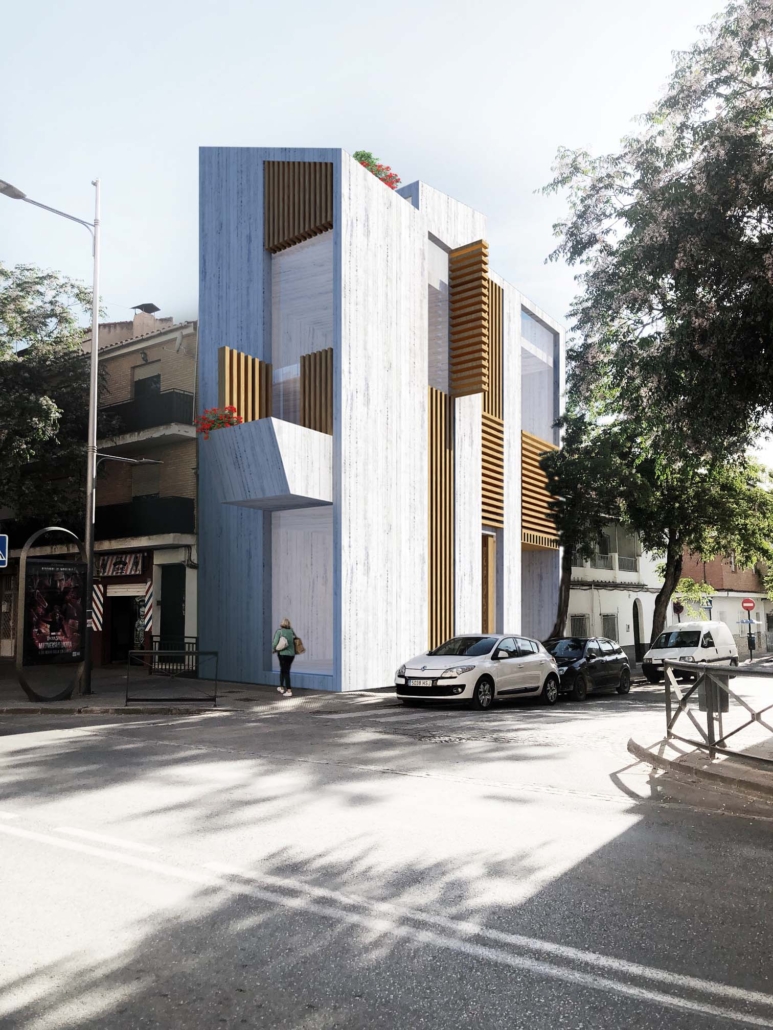
In this strategic location—neither Vega nor city, yet deeply connected to both—a new multi-family residential building with a commercial ground floor is proposed. It is an architectural piece whose intention is not only to occupy a plot but to engage in dialogue with the agricultural memory of the territory and with the urban dynamics of a Granada that is transforming at the rhythm of the 21st century.
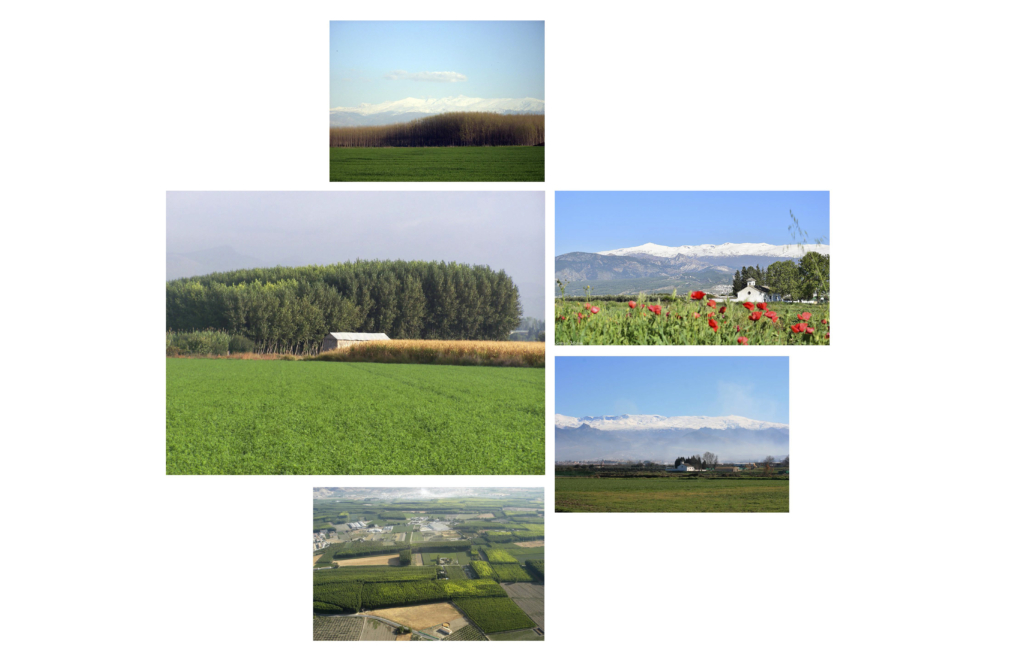
THE VEGA AS ORIGIN: TERRITORIAL MEMORY IN ARCHITECTURAL FORMS
The images of the Vega of Granada—green fields of alfalfa, poplar groves framing the horizon, clear skies, and Sierra Nevada in the background—depict a landscape that has served as the economic, identity-based, and aesthetic foundation of the city for centuries. But the Vega is not only geography: it is architecture.
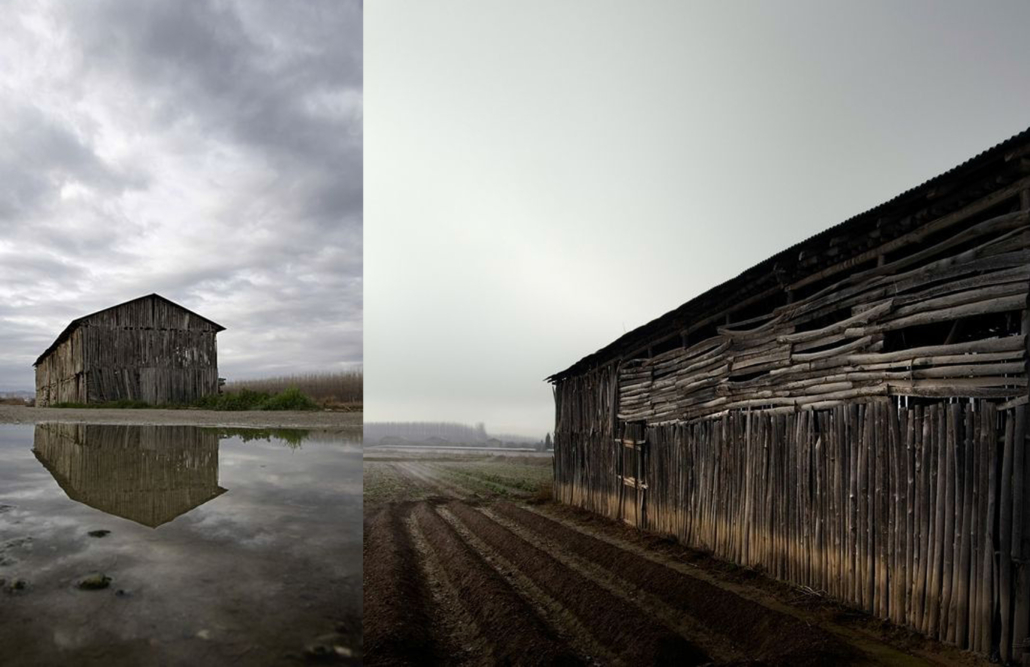
THE DRYING SHEDS OF THE VEGA: A QUIET BUT DEFINING TYPOLOGY
The traditional drying sheds, built from wooden slats that allowed ventilation for tobacco or corn, are essential structures of this agricultural landscape. Their simple forms—prismatic volumes, walls textured with vertical wooden strips, sloped roofs—constitute an anonymous architecture deeply linked to Granada’s agricultural history.
These structures function as climate-responsive shelters: buildings where light filters through, air circulates freely, and materiality breathes. The project on Avenida de Dílar incorporates this tradition not as nostalgia but as a contemporary reinterpretation.
A BUILDING THAT ABSORBS THE LANDSCAPE
The project begins with a clear premise: if the building looks toward the city, it must also remember that Granada once was, is, and will always be shaped by the Vega. To achieve this, three conceptual operations are employed:
– A verticalized volume, evoking the isolated drying sheds standing among the fields.
– Slats and openings that reinterpret the wooden latticework of traditional sheds.
– A sober material palette, from concrete grey to the warm tones of wood.
Each of these gestures allows the façade to function not only as a boundary but as an environmental device and an evocative surface that recalls the agricultural landscape.
AVENIDA DE DÍLAR AS A THRESHOLD
For decades, Avenida de Dílar has been a neighborhood street, defined by small shops and mid-rise residential buildings. Today, its role is shifting: it is becoming a structuring axis linking the traditional Zaidín, the urbanized Vega, the Health Technology Park, and new residential developments.
THE BUILDING AS AN URBAN HINGE
The ground-floor commercial space activates the street, while the upper-level dwellings reinterpret the natural light and ventilation strategies characteristic of the drying sheds.
ARCHITECTURE AS SYNTHESIS
The project acknowledges that Granada cannot be understood without embracing its dual identity: the historic city and the agricultural city. For this reason, the proposal is not conceived as an isolated volume but as research into how agricultural memory can become a contemporary urban reference.
At a moment when Granada is redefining its relationship with the Vega, this project proposes an architecture that recognizes its place, translates its history into new forms, and stands as a landmark for a city that progresses without abandoning its memory.
Avenida de Dílar thus becomes a corridor where agricultural past and urban future meet. Along this line of transition, the new building emerges as a symbol of continuity: the Vega we once were and the city we are constructing today.

